How 5g is reshaping live news gathering and remote production for broadcasters and digital-first video teams
How 5g is reshaping live news gathering and remote production for broadcasters and digital-first video teams
For years, live news and remote production have been chained to the same old villains: satellite trucks, tangled cables, and the eternal hunt for “just one more bar” of 4G. Now 5G is crashing the party, and it’s not just another G in the spec sheet — it’s quietly rewiring how broadcasters and digital-first teams think about gathering, producing, and distributing live content.
If you’re still picturing 5G as “faster mobile internet,” you’re underestimating it in the same way people once underestimated streaming video. (Remember when everyone thought YouTube was just for cat videos?) The shift we’re seeing in live news and remote production is deeper: it’s about workflows, staffing, cost models, and what “live” even means.
From satellite trucks to backpacks: how we got here
Before we talk 5G, it’s worth remembering how painful live used to be.
Traditional live news gathering relied on:
- Satellite and microwave trucks parked as close as possible to the action
- Lengthy setup times and line-of-sight constraints
- High operating costs and lots of specialized staff
Bonded cellular (3G/4G) started to change the game. Backpack encoders from companies like LiveU, TVU, Dejero and others allowed reporters to go live from almost anywhere with decent mobile coverage, using multiple SIMs to bond connections together.
But 4G had limits: network congestion during major events, higher latency, variable uplink speeds, and reliability issues in dense urban areas. Great for many use cases, but not quite “studio-grade” for everything.
5G doesn’t magically erase all of that, but it does start to remove some of the hard constraints that shaped how we work. And that’s where it gets interesting.
What 5G really brings to the live production table
Let’s strip away the marketing buzzwords and focus on what actually matters for newsrooms and video teams.
- Higher uplink bandwidth – Not just faster downloads; 5G can dramatically improve upload speeds, which is what live video needs.
- Lower latency – Sub-20 ms in ideal conditions, which gets you closer to “feels like a cable feed” territory.
- Network slicing – Operators can carve out dedicated slices of the network just for broadcasters or specific events, giving you guaranteed quality of service.
- Massive device density – A stadium full of phones, cameras, and encoders all streaming at once becomes more manageable.
For live news and remote production, that translates into two big shifts:
- More locations where you can go live reliably
- More production tasks that can be offloaded to remote control rooms or the cloud
In other words, 5G isn’t just a better cable — it’s a new assumption. You can assume that in many major cities, venues, and eventually even smaller towns, you’ll have a robust, low-latency pipe available to you wirelessly. That assumption unlocks a lot of creativity.
Live news gathering: turning any reporter into a mobile studio
On the news side, 5G’s most immediate impact is at the point of capture.
Instead of building coverage plans around where you can park a truck or pull a line, editorial decisions can focus on where the story is strongest. The tech follows, instead of leading.
We’re already seeing broadcasters and digital-first operations use 5G to:
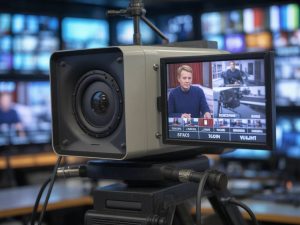
- Go live with fewer people on site – A single reporter with a 5G-enabled camera or backpack encoder can deliver a live hit that previously required a truck, an engineer, and a camera op.
- Stream higher-quality video from mobile devices – 1080p (and even 4K in controlled scenarios) live hits over 5G from a smartphone paired with a small rig are now realistic, not sci-fi.
- Handle breaking news more flexibly – Producers can spin up multiple live contributions from different locations quickly, coordinating them from a central hub.
Think about a protest or a natural disaster: these are exactly the environments where fixed infrastructure may be limited or overloaded. With 5G, newsrooms can deploy multiple teams with lightweight kits and still maintain quality and stability that used to require heavy hardware.
Some early adopters are going further: they’re equipping freelance stringers and digital-native creators with 5G-capable kits and integrated apps that feed directly into the newsroom ingest systems. When a story breaks, the nearest approved contributor can be live in the rundown in minutes.
Remote production: the control room goes virtual
Where 5G gets really transformative is in remote production — not just getting a signal back, but running the entire show from somewhere else.
In a traditional setup, big live events needed big onsite infrastructures: OB trucks, large crews, multiple control rooms, racks of gear. It was effective, but expensive and inflexible.
With 5G and IP-based workflows, you can:
- Capture multiple camera feeds at the venue
- Send them back over 5G (and/or fixed IP) in near real time
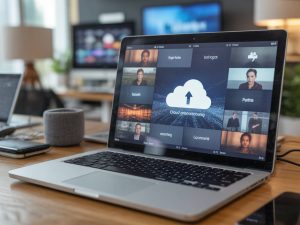
- Switch, mix, graphics, and record everything in a centralized control room or in the cloud
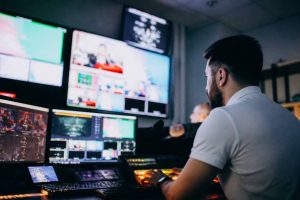
That means fewer people traveling, smaller onsite footprints, and more shows produced from a single centralized operations hub. For digital-first video teams, that “hub” might be a cloud-based control room rather than a physical building, but the principle is the same.
Sports, music festivals, political debates, e-sports — they’re all testing or deploying 5G-powered remote production. The end goal is clear: maximize content output while reducing per-event costs and carbon footprints.
Newsrooms go hybrid: broadcast and digital in the same 5G pipeline
The most forward-looking teams aren’t just using 5G as an input into traditional broadcast; they’re building hybrid pipelines that serve TV, OTT, social, and owned platforms simultaneously.
Here’s what that looks like in practice:
- A field reporter sends a 5G live feed into a central hub.
- The same feed is:
- Clean-switched and sent to the linear broadcast
- Clipped into vertical formats for TikTok, Instagram, YouTube Shorts
- Transcoded into lower-bitrate adaptive streams for mobile apps and websites
- Captured with clean audio for later podcast or radio segments
Because 5G improves the reliability and quality of the input signal, you have more options in post: better keying for graphics, more flexibility in cropping, and fewer “we’d love to reuse this, but the quality just isn’t there” situations.
This is especially valuable for digital-first teams who live in a multi-platform, multi-aspect-ratio world. The same 5G-enabled live hit can generate a whole content bundle — not just one broadcast moment.
Field stories: when 5G actually saves the show
A few real-world style scenarios (with details lightly anonymized) hint at how 5G is already changing habits:
- The weather team that ditched the truck
A regional broadcaster outfitted its weather reporters with 5G backpacks and compact cameras. For severe weather coverage, they can now move quickly between locations, pushing multiple live hits per hour without worrying about where to park the truck or whether the roof can support a big microwave mast. - The music festival with no OB truck
A digital-first media company covering a major music festival used 5G to send camera feeds (main stage plus roaming ENG-style cameras) back to a remote production hub. Graphics, multi-language commentary, and social cutdowns were all handled off-site. The onsite footprint was essentially: cameras, encoders, a small tech team, and a lot of sunscreen. - The pop-up political debate stream
A news outlet used 5G-enabled smartphones for audience interaction views (reaction shots, queuing questions from the crowd) that were mixed into a main program captured by more traditional cameras. Allthose signals went back into a cloud-based switcher. The result felt premium, but the execution was closer to “pop-up remote” than “full-scale broadcast.”
Each of these use cases has existed in some form with 4G and Wi-Fi, but 5G’s stability and throughput make them reliable enough for prime-time, not just “if everything goes right.”
What this means for smaller, digital-first teams
Large broadcasters have been piloting 5G for a while, often in partnerships with telcos. But some of the most interesting changes are happening with smaller, digital-first teams that don’t have legacy infrastructure holding them back.
For these teams, 5G can mean:
- Studio-level live from the backpack – A compact setup (camera + 5G encoder or even a 5G phone with external audio) can deliver a live product that feels professional enough for branded shows or sponsored coverage.
- Remote crews without offices – Producers, graphics ops, and technical directors can all work from home or co-working spaces, meeting in the cloud to run live shows fed by 5G cameras in the field.
- Scaling up without buying trucks – Instead of major capex on OB vehicles and satellite capacity, teams can invest in IP gear, cloud production platforms, and talent.
For an upstart news brand or creator-led media company, this changes the math. National or even global live coverage no longer automatically requires a legacy broadcaster’s budget.
The technical caveats: it’s not magic, it’s networking
Of course, 5G isn’t a cheat code that makes every live stream perfect. There are caveats you ignore at your peril:
- Coverage is uneven – Urban centers and major venues are usually early winners; rural or remote areas may see slower rollouts.
- Not all 5G is the same – Low-band 5G offers coverage but modest speed gains; mid-band and mmWave can deliver huge bandwidth but shorter range and more challenges indoors.
- Congestion still matters – 5G handles density better than 4G, but a packed stadium all live-streaming at once can still push networks to the edge.
- Gear choices are critical – Bonded encoders that combine 5G with 4G and Wi-Fi, support SRT/RIST, and offer robust error correction are still your friends.
The smartest operations treat 5G as one transport option in a resilient IP workflow. They bond multiple connections, plan for failover, and keep operational playbooks for “when the network gods are not on our side today.”
Security, QoS, and network slicing: the less sexy, more powerful side
Under the hood, 5G introduces some features that may not be as flashy in a demo, but matter a lot in real life:
- Private 5G networks – Broadcasters and event organizers can deploy private 5G in venues or production centers for guaranteed performance and security.
- Network slicing for media – Telecom operators can allocate dedicated slices for media traffic during big events, making your live feeds much less vulnerable to “everyone posting selfies” traffic.
- More granular QoS controls – Prioritizing video contribution traffic over less critical data becomes more feasible.
This is where 5G stops being “just a faster mobile network” and becomes part of your infrastructure planning. For global media brands, negotiating access to premium slices or private setups is already part of 5G-era strategy.
How to get ready: practical steps for broadcasters and digital teams
If you’re planning your next-generation live workflow, 5G should be on the whiteboard. A few practical steps:
- Audit your current live workflows
Map where you’re still dependent on satellite, fixed lines, or heavy on-site resources. These are your best candidates for 5G-inclusive trials. - Invest in 5G-capable contribution gear
Look for encoders and cameras that support:- 5G (with support for multiple carriers/SIMs)
- SRT/RIST or similar low-latency contribution protocols
- Remote management (so your engineers don’t need to be on site)
- Build remote production playbooks
Start with lower-risk events and gradually move up to more critical shows as your team gains confidence. - Talk to telcos early
If major events are part of your calendar, start conversations around network planning, potential slicing, or private 5G deployments. - Train editorial teams
The tech is only part of the story. Reporters, field producers, and digital teams need to understand what 5G enables — and its limits — so they can pitch and plan stories accordingly.
What’s next: towards ultra-responsive, multi-view, interactive live
As 5G networks mature and cloud production tools evolve, we’re heading toward a world where:
- Viewers can switch between multiple live angles in near real time
- Low-latency interaction (chat, polls, UGC) feels genuinely live, not “live-ish”
- AR graphics and data overlays are composited in the cloud and personalized per viewer
- Journalists in the field interact seamlessly with mixed reality elements, rendered and synchronized over IP
For broadcasters, that means the line between “traditional TV” and “digital interactive” gets thinner by the day. For digital-first teams, it’s a chance to play in formats that once demanded a whole broadcast center, armed with little more than good storytelling instincts, a tight workflow, and a few well-placed 5G devices.
Live news and remote production are no longer defined by how far your cables can reach or how fast you can deploy a truck. They’re defined by how cleverly you can orchestrate IP connections, cloud tools, and human talent — with 5G as the connective tissue making those orchestras possible in more places, more often.
If the shift from tape to file, and from satellite to IP, reshaped entire broadcast organizations, the shift to 5G-powered, remote-first production is about to do the same. The teams that win won’t be the ones with the shiniest trucks; they’ll be the ones who treat the network itself as the new studio.