


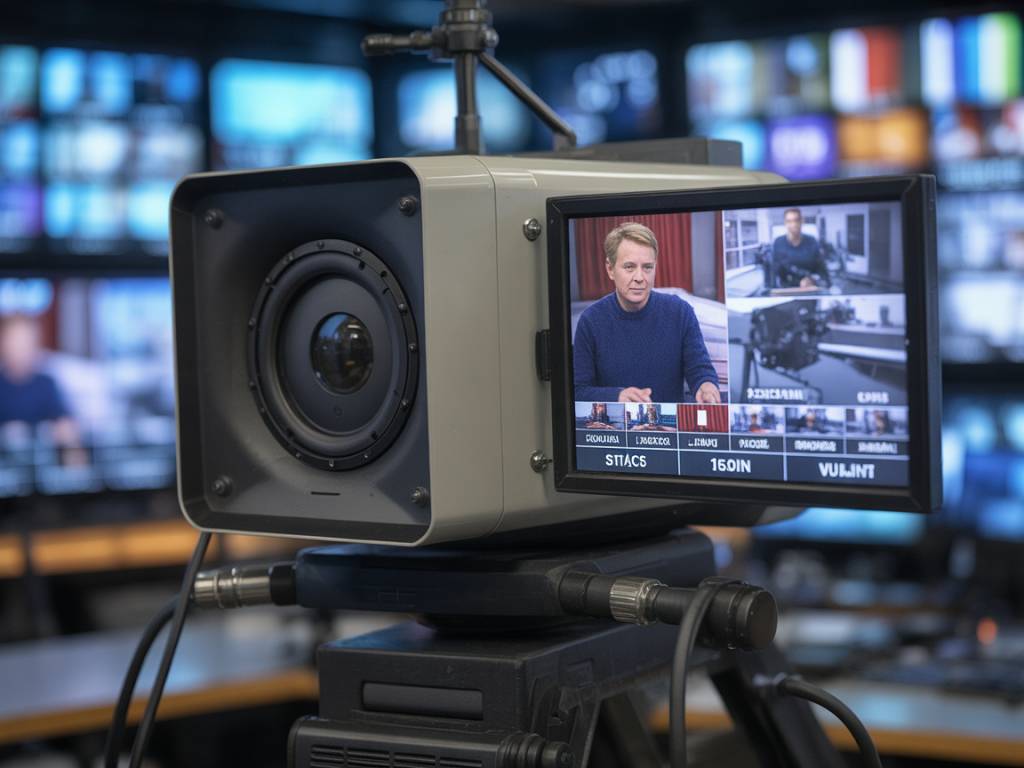
Local TV has always been about doing a lot with very little: small teams, tight deadlines, and a control room that feels more like a spaceship than a workplace. Now add AI into that mix and you don’t just get a shinier spaceship — you get an entirely new flight plan.
Across local stations, AI is quietly sliding into live broadcast workflows and everyday newsroom routines. It’s scheduling clips, suggesting lower-thirds, translating interviews, and yes, even helping directors keep breaking news segments from turning into on-air train wrecks.
This isn’t science fiction or a Silicon Valley demo reel. It’s happening in real control rooms, with real producers who still measure time in “minutes to air.” Let’s unpack how AI is actually changing live production and newsroom operations on the ground — and what that means for the next generation of local TV.
From “we’ll fix it in post” to “we’ll fix it in real time”
Traditionally, AI in video was something you’d associate with post-production: cleaning audio, stabilizing shaky footage, auto-color correction for promos. Local TV stations didn’t always have the luxury to use those tools — the show was live, the clock was relentless, and “good enough” usually beat “perfect.”
Today, the most interesting shift is that AI is moving upstream into live workflows:
- Real-time transcription and captioning embedded directly into the production chain.
- AI-assisted rundown management that predicts timing issues before they blow up the back half of your show.
- Automated camera framing and tracking that adjusts on the fly during a live hit in the field.
In other words, AI is no longer something you “apply” to your content after the fact. It’s becoming part of the air chain itself, sitting right alongside your switcher, graphics engine, and automation system.
For local stations trying to do more live content on more platforms (linear, FAST, social, web), that shift is exactly where the leverage is.
AI in the control room: smarter switching, fewer fire drills
Walk into a modern control room and you’ll see automation everywhere: MOS-integrated rundowns, template-based graphics, robotic cameras, playout servers. AI is joining that stack in some very specific, very practical ways.
1. AI-assisted production automation
Automated production systems have been around for years, but they were often rigid: if the script changed on the fly, the automation didn’t always keep up gracefully. Now, AI is making these systems more adaptive.
- Dynamic shot selection: Computer vision can detect who is speaking and automatically switch or reframe cameras in single-anchor or panel setups.
- Prompt-aware automation: AI can parse the teleprompter or rundown text and anticipate upcoming shots, graphics, or clips, even when producers improvise.
- Fallback logic: When a clip doesn’t roll or a source fails, AI-assisted systems can recommend the “least bad” next action — stay on camera, go to generic full-screen graphic, or trigger a backup source.
Think of it less as a robot-director replacing humans, and more as a very fast, very focused assistant watching for the errors humans don’t have time to predict.
2. Real-time quality control
Local stations live in fear of the dreaded “black screen,” dead audio, or wildly mismatched loudness between live hits and pre-produced packages. AI-based monitoring tools are starting to quietly police these issues in real time:
- Loudness normalization: AI models analyze and level audio on the fly, saving your audience from scrambling for the remote during transitions.
- Freeze and black detection: Computer vision flags frozen video, black frames, or corrupted feeds and can automatically switch to backup content.
- Graphic and bug verification: Some systems can confirm that your logo bug, lower-third, or sponsor bug is actually visible and correctly triggered at the right moments.
For a local station that might be running multiple live channels (main, subchannel, OTT stream), having AI watch your outputs 24/7 is like finally getting that extra technical director you couldn’t afford.
3. AI-powered captioning and translation
Automatic speech recognition has improved to the point where AI-generated captions are no longer a novelty — they’re rapidly becoming baseline. For live news, that’s a game-changer:
- Live captions: Cloud-based ASR engines can generate real-time captions directly into broadcast and streaming workflows, reducing reliance on expensive phone-line stenography services.
- Multilingual outputs: Some stations are already experimenting with parallel Spanish-language captions (or even dubbed audio) for major events, created via real-time AI translation.
For local broadcasters in multilingual markets, this isn’t just accessibility. It’s reach. That high school board meeting or mayoral press conference can suddenly serve multiple language audiences with minimal additional staff.
Augmenting, not replacing, the newsroom
When journalists hear “AI in the newsroom,” the first reaction is often anxiety: is the algorithm coming for my job? The reality, at least today, looks more like augmentation than replacement — especially at the local level.
1. Drafting, not deciding
Generative AI tools are increasingly embedded into newsroom systems, but their role is to draft, summarize, and adapt — not to originate editorial decisions.
- Story summaries: AI can ingest a police report, court document, or press release and generate a short summary for web, mobile push, or social posts.
- Script variants: From a main script, AI can suggest shorter versions for teasers, promos, or OTT news updates.
- Platform-specific rewrites: The same core story can be rephrased for TikTok, YouTube description, or a newsletter blurb, preserving key facts but matching the tone of each platform.
The journalism still comes from humans: choosing what to cover, verifying information, asking hard questions. AI just takes some of the repetitive linguistic heavy lifting off their plate.
2. Research and background in seconds
AI-powered search and summarization tools can crunch through archives, public data, and previous coverage at a speed no intern can match:
- Need a “here’s how we got here” explainer for tonight’s lead story? AI can surface prior packages, web articles, and relevant B-roll in seconds.
- Covering a recurring local policy issue? AI can summarize key milestones, previous city council votes, and past soundbites from the same officials.
The result isn’t that reporters do less work — it’s that they can spend more time on meaning and context instead of digging through folders named “final_FINAL_v3_last-really-final.”
3. Newsroom-language translation
Beyond audience-facing translation, AI is helping newsrooms themselves work across language barriers. In markets with multilingual crews or regional content sharing, AI can:
- Translate scripts between English, Spanish, and other languages for regional partner stations.
- Provide fast, rough translations of interviews or statements, allowing journalists to decide what’s worth sending for human translation or deeper verification.
Is it perfect? No. But as a triage tool, it’s enormously powerful — and it shrinks the gap between “we’d like to cover this community” and “we actually can, today.”
Computer vision in the field: from chaos to clean feeds
Live shots have always been a mix of art and chaos: unstable tripods, unpredictable crowds, bad lighting, and that one person who always finds the camera. AI is starting to bring more order to the madness.
1. Auto-framing and tracking
Paired with robotic or PTZ cameras, AI can identify faces and bodies, then keep them properly framed as they move:
- Solo MMJs can set up a camera, walk into frame, and trust the system to keep them centered while they report live.
- During a live city hall press conference, AI tracking can follow the current speaker without relying on a camera op glued to the joystick.
The result is less “security cam aesthetic” and more stable, intentional framing — even when there’s no dedicated camera operator on location.
2. Object recognition and on-the-fly graphics
Computer vision can recognize logos, landmarks, sports actions, and weather patterns, feeding that data into your graphics and storytelling:
- Sports: AI can detect goals, touchdowns, or key plays, automatically clipping highlight moments and inserting basic stats overlays.
- Traffic: AI tools monitoring DOT cameras can identify congestion and incidents, suggesting relevant shots to producers and pre-generating lower-thirds like “ACCIDENT: I-95 SOUTHBOUND NEAR EXIT 24.”
- Weather: Vision models can analyze radar and satellite imagery to highlight specific storm cells or risk zones, making it easier to generate precise, localized graphics quickly.
For stations that have to convert raw feeds into coherent stories at speed, that automation isn’t just nice to have — it helps them keep up with national players on digital platforms.
Metadata, archives, and the searchable newsroom
Every station has an archive. Few have a useful archive. Tapes, LTO, random NAS folders — and that one engineer who knows where everything is, but only if you catch them before lunch.
AI is changing that equation through large-scale, automated metadata enrichment.
1. Auto-tagging everything
Modern AI models can analyze video and audio to generate rich metadata without manual logging:
- Who is speaking (speaker ID / face recognition, where allowed and properly managed).
- What is being said (transcription and keyword extraction).
- What’s on screen (locations, logos, objects, on-screen text).
That data can be fed back into MAM or DAM systems, turning “random B-roll from 2013” into “night aerials of downtown + snowy streets + light traffic.” Suddenly, that footage is findable.
2. Faster story turnarounds
When archives are AI-tagged and searchable, producers and editors can:
- Pull relevant B-roll in minutes instead of hours.
- Build anniversary or “on this day” segments with deep historical footage.
- Quickly fact-check whether a public figure really did “always say” the thing they’re claiming.
In a world where newsworthiness often comes down to “we can turn this package in time for the 6 p.m. show,” that speed matters.
New roles, new skills for local stations
AI doesn’t just change tools; it changes jobs. Local broadcasters are already seeing subtle shifts in what their teams need to know and do.
1. The rise of the “workflow editor”
Beyond traditional roles (producer, TD, ENG editor), stations are starting to need people who understand how to stitch AI tools into existing systems.
- Configuring AI captioning and verifying accuracy thresholds.
- Maintaining metadata taxonomies for auto-tagged archives.
- Defining guardrails: what AI can draft, and what must stay human-only.
This hybrid profile — part technical producer, part automation strategist — is becoming critical as stations juggle linear, OTT, and digital formats.
2. Journalists as AI editors
Reporters and producers don’t have to become data scientists, but they do need to get comfortable editing AI outputs:
- Checking AI-generated summaries for nuance and missing context.
- Spotting hallucinations or overly confident errors in research outputs.
- Understanding when a translation or transcription is “good enough for internal use” vs. “needs human review before air.”
In a way, this is an extension of skills journalists already have: skepticism, verification, and a nose for things that don’t quite sound right.
3. Ethics and transparency become everyday tasks
As AI enters editorial workflows, local stations are having to define policies they never needed before:
- Will you disclose on-air when an image or graphic has been AI-generated?
- How will you avoid deepfake misuse or accidental amplification?
- What editorial sign-off is required before AI-produced content reaches the audience?
The upside: stations that build clear practices now can differentiate themselves as trusted, responsible sources in an era when synthetic media is everywhere.
Practical roadmap: how to experiment without breaking the 6 p.m. show
All of this sounds promising, but local TV reality is brutal: limited budgets, aging infrastructure, and zero tolerance for failure during live news. So how do you introduce AI without turning your control room into a beta test lab at 5:59 p.m.?
1. Start with “sidecar” workflows
Instead of plugging AI directly into your live switcher on day one, run it in parallel:
- Use AI captioning alongside your existing captions and compare results quietly.
- Let AI generate script summaries, but keep them internal at first to see how accurate and useful they are.
- Test AI-based monitoring (freeze, loudness, logo placement) as an advisory layer before allowing it to trigger automatic failover.
This reduces risk while giving your team time to build trust in the tools.
2. Pick use cases that remove drudgery, not identity
Early wins come from tasks your team doesn’t love:
- Routine clipping of press conferences into shareable segments.
- Batch transcription of interviews for internal research.
- Auto-tagging archive footage instead of manual logging.
When people see AI taking over boring work instead of creative work, adoption goes up and resistance goes down.
3. Train for judgment, not button-pushing
AI-heavy workflows fail when teams treat them as magic boxes. They succeed when people understand:
- What the system is doing under the hood, at a high level.
- Where it’s most likely to go wrong (names, accents, niche topics, local references).
- Which outputs need human review before going to air or online.
Investing a few structured workshops or brown-bag sessions into this kind of training often has more impact than buying yet another shiny tool.
4. Keep your tech stack modular
AI is evolving fast, and vendor lock-in can be brutal. When integrating AI into broadcast and newsroom systems, prioritize:
- Open or well-documented APIs.
- Standards-based connections (SRT, NDI, SMPTE ST 2110 where applicable, MOS for newsroom).
- Vendors who can plug into your existing MAM, NRCS, and automation, not replace them wholesale.
This makes it possible to swap out components as better AI models arrive — without ripping out half your workflow every 18 months.
Local broadcasters are used to change: SD to HD, analog to digital, linear-only to “be on every screen everywhere all the time.” AI is just the next wave — but it’s one that seeps into every layer of how content is created, managed, and delivered.
Handled thoughtfully, AI can give local stations something they’ve never really had at scale: the ability to operate like a much bigger shop without losing the community focus that makes them unique.
The cameras, switchers, and transmitters may still look familiar, but behind the scenes the newsroom brain is getting an upgrade — and it’s learning, very quickly, how to help the humans tell better stories, faster, on every screen that matters.